



Over the years, empirical studies have found:
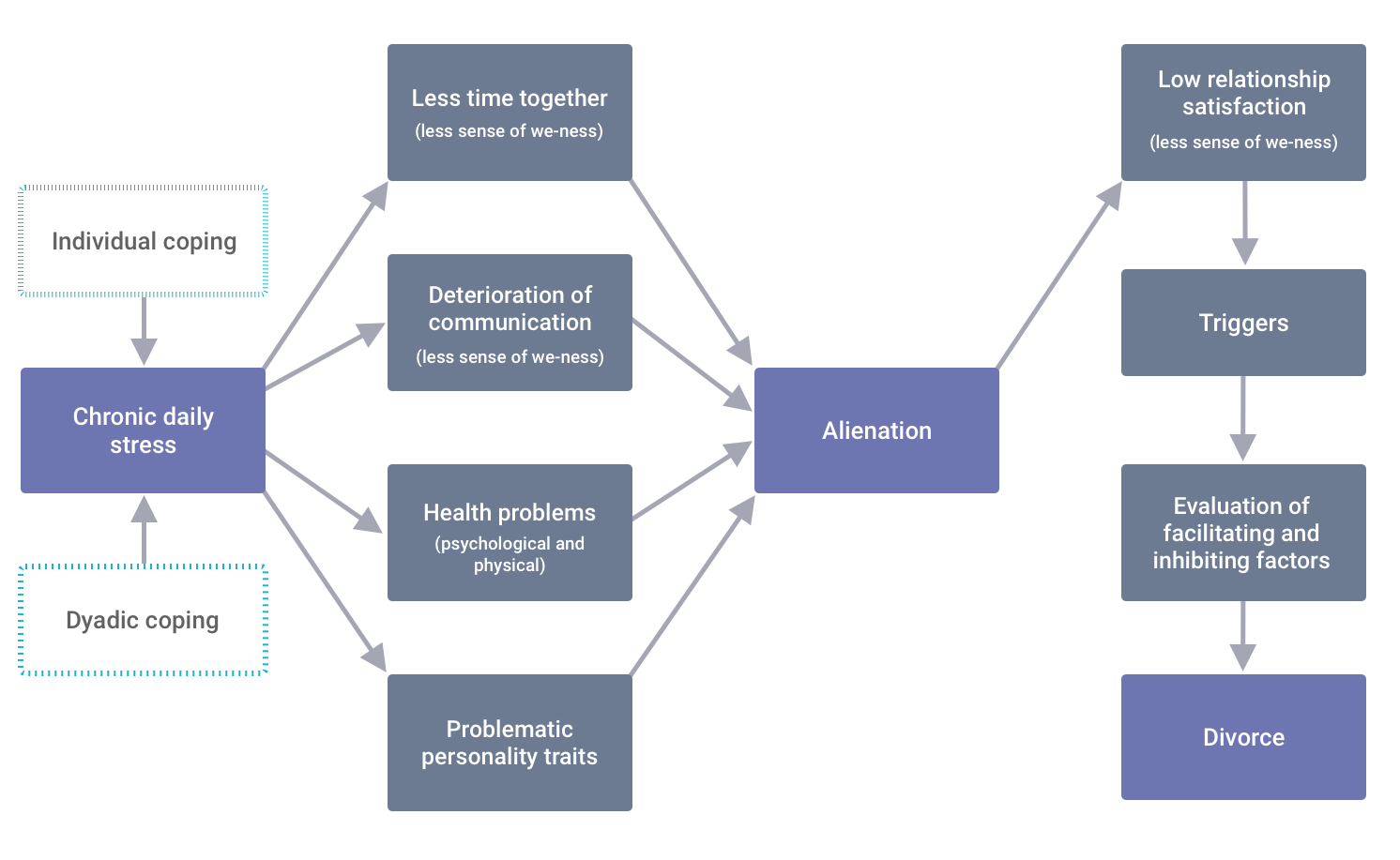
This internationally recognised theory of stress and coping in couples and families opens the possibility for interventions to promote dyadic coping. One partner supports the other, or both partners engage in shared problem-solving and emotion regulation. In this way the relationship becomes a resource for the couple.
This resource is based on Couples Coping Enhancement Training (CCET).This emerged from a large number of international studies and interventions which showed that enhanced couple coping is associated with improved relationship satisfaction, relationship stability, and wellbeing [2] [3].
Dyadic coping can be illustrated by a rowing boat analogy. When one partner is stressed, the other partner shouldn’t take over completely, but rather slowdown so that both partners can keep rowing together, at a pace they can manage as a couple.
Couples can learn the process of dyadic coping through the funnel method of talking and listening. The stressed partner tells their partner about the stress, clearly stating the facts, the thoughts and feelings, and why it bothered them so much. The supporting partner then summarises the important points their partner has made, using empathetic listening and open-ended questions if clarification is needed.

Listening in this way makes it easier to offer emotional support first rather than jumping to offer practical support or advice. In a supportive relationship, stress is shared and understood, and the couple are able to solve problems more effectively.
If both parents are stressed, they may need to take turns using the funnel method so they can support each other. If you are only working with one parent, they can still learn this technique and role model these skills to the other parent.

Research studies have shown that sharing stress in this way not only results in improved relationship quality but can have other benefits such as abstinence from smoking and alcohol misuse [4].
When parents cope better with stress, they may argue less, which can lead to improved outcomes for children. Parents are more likely to be able to provide reactive and empathetic parenting and reduce instances of conflict where their children are put in the middle.
Evidence shows that frequent, intense, and poorly resolved conflict causes stress and depression for the whole family. It can even undermine children’s education and employment prospects [5] [6]. A poor-quality parental couple relationship also puts children at risk of relationship difficulties in their own adult couple relationships, creating an intergenerational cycle of relationship distress. This is worse where there is poverty and financial pressure [7].
Conflict behaviours can be characterised as destructive (relationship-damaging) or constructive (relationship-enhancing) [7]. John Gottman [8] refers to the different destructive conflict behaviours as the four horsemen of the apocalypse:
When couples engage in destructive conflict, it is like a ping pong ball being batted back and forth. It becomes hard to engage positively and constructively. Things will start to go downhill quickly, and the couple will end up worse off – it’s a downward spiral leading to relationship breakdown.
The model for developing constructive conflict skills is underpinned by a cognitive behavioural approach [9]. It begins with self-assessment, which helps parents identify unhelpful thought processes and behaviour patterns and promotes the use of more positive adaptive thinking and behaviours.
Some of the film clips in this resource use Behaviour Modelling Training [10], an effective technique for promoting behaviour change. This technique is based on social learning theory [11] and uses visual demonstrations of behaviours to promote knowledge and the acquisition of skills. It provides participants with opportunities for feedback and social reinforcement to maximise transfer of behaviours.
A solution-focused questioning style explores couples’ goals in the context of their current resources and behaviours [12]. Therapeutic elements may include:
Progress scales. Where are you now? What will it take to get you to the next point on the scale? When you have argued before what did you do that helped?
