Evidence for ‘Me, You and Baby Too’
In 2017 OnePlusOne was commissioned to design, develop and trial a digital behaviour change intervention (DBCI) to support and strengthen parental couple relationships for disadvantaged and vulnerable families.
We have taken the latest evidence on strengthening couple relationships and reducing parental conflict [1] [2] and built an effective digital resource [3] to help new and expectant parents:
- Adapt to the changes that having a baby is likely to have on their relationship.
- Manage their stress together.
- Argue in ways that are more constructive and less harmful to their children.
Becoming parents
A strong parental couple relationship provides the emotional bedrock for the healthy development of babies and children, particularly in the early years. But for many couples, becoming parents can be challenging and stressful.
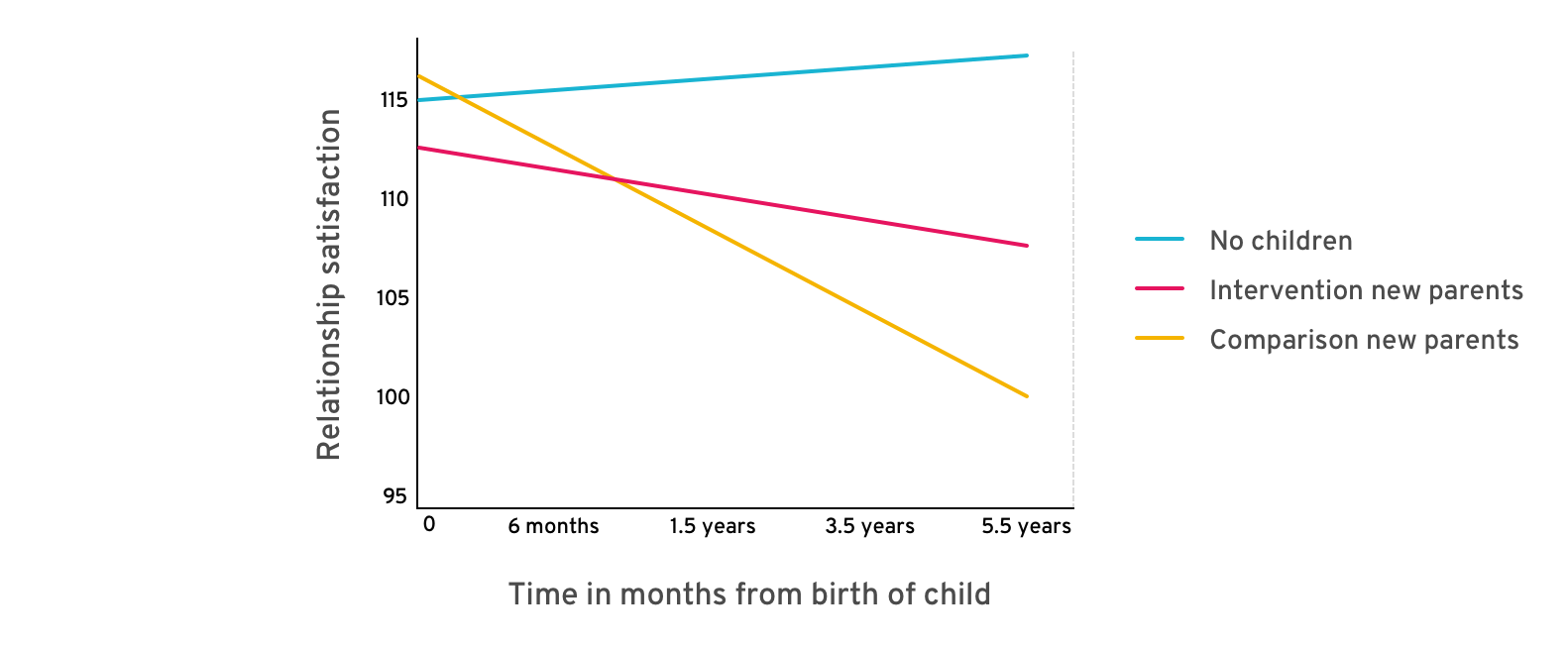
Differences in values and expectations can become magnified when parents are tired and stressed. Couples often experience a dip in relationship satisfaction and are likely to argue more [4]. When conflicts between parents are destructive – frequent, intense, poorly resolved, or about the child – the impact on children can be seen from infancy [5].
Financial and social constraints can create further challenges [6]. If the pattern of decline continues, it can lead to family instability and relationship breakdown.
But having a baby is also a time of opportunity. Parents’ motivation is often higher and there is a chance to intervene early, strengthening the parental relationship and making a real difference to the family’s outcomes.
The vulnerability stress adaptation model
It is well established that the quality of the couple relationship impacts the health and wellbeing of adults and children. Researchers have drawn on a range of data from many different samples of couples to identify which factors influence relationship quality.
An influential and very comprehensive theoretical model has emerged from the work of [7], which provides a useful way of understanding what happens to couples when they are facing stressful life events and transitions. In brief, the vulnerability stress adaptation (VSA) model helps us to understand the impact of stressful life events in the context of individuals’ past experiences and the methods they use to adapt in these circumstances:
- Enduring vulnerabilities. Personal traits and past experiences that each person brings to the relationship which are often related to attachment patterns.
- Stressful events. The life events they encounter, such as having a baby, illness, and unemployment, increase partners’ need for support at the same time as reducing their capacity to provide it.
- Adaptive processes. How the couple communicate, behave, and cope during difficult times.
Helpful websites
OnePlusOne: www.oneplusone.org.uk
Relate: www.relate.org.uk
Tavistock Relationships: www.tavistockrelationships.org
Early Intervention Foundation: www.eif.org.uk
References
[1] Reynolds,J., Houlston, C., Coleman, L. and Harold, G. (2014) Parent conflict: Outcomes and interventions for children and families.London: Policy Press.
[2] Harold, G.T., Acquah, D., Sellers, R., Chowdry, H. and Feinstein, L. (2016). What works to enhance inter-parental relationships and improve outcomes for children. London: EarlyIntervention Foundation.
[3] Michie, S., Yardley, L., West, R., Patrick, K. and Greaves, F. (2017)Developing and evaluating digital interventions to promote behaviour change in health and health care: Recommendations resulting from an international workshop. Journal of Medical Internet Research,19(6): e232. doi: 10.2196/jmir.7126
[4] Hirschberger,G., Srivastava, S., Marsh, P., Cowan, C. P. and Cowan, P. A (2009)Attachment, marital satisfaction, and divorce during the first fifteen years of parenthood. Personal Relationships, 16(3), pp. 401-420.
[5] Schulz, M.S., Cowan, C. P. and Cowan, P. A. (2006). Promoting healthy beginnings: A randomised controlled trial of a preventive intervention to preserve marital quality during the transition to parenthood. Journal of Consulting and Clinical Psychology, 74(1), pp. 20–31.
[6] Acquah, D.,Sellars, R. and Harold, G. (2017) Inter-parental conflict and outcomes for children in the contexts of poverty and economic pressure. London: Early Intervention Foundation.
[7] Karney B.R. and Bradbury, T.N. (1995).The longitudinal course of marital quality and stability: A review of theory, method, and research. PsychologicalBulletin, 118(1), pp. 3-34. doi: 10.1037/0033-2909.118.1.3.