

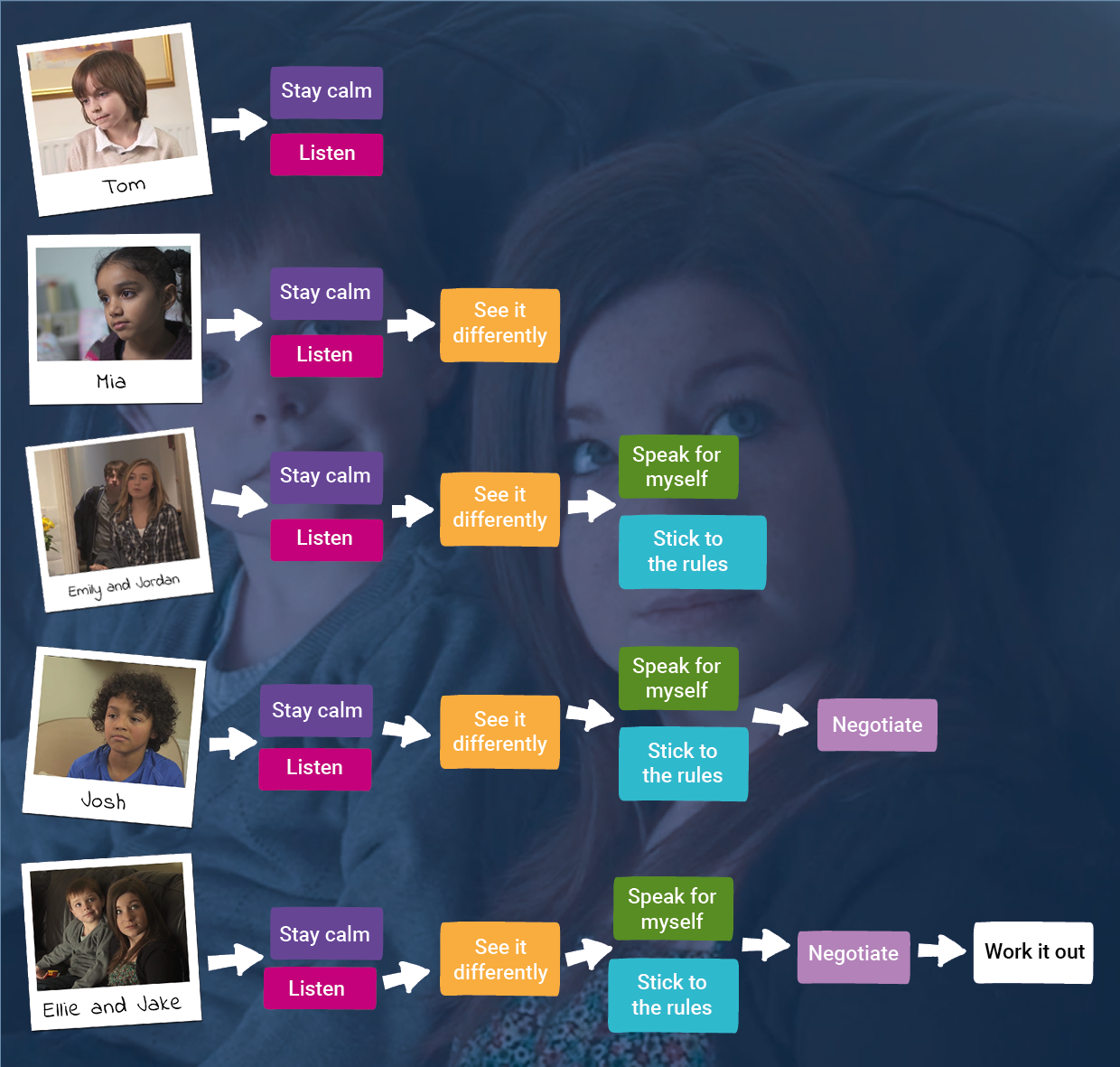
Tom gets caught in the middle of an argument about financial arrangements, where he has been asked to pass message between his parents. This scenario covers the basics of staying calm and listening.
Mia is pressed for information about the time she spends with her other parent. This scenario explores the skill of seeing things differently, becoming aware of the impact on the child, and using conflict management skills with an ex-partner over email.

Emily and Jordan have a difficult time adjusting between family homes and find themselves defending one parent to the other. This scenario looks at how parents can set blame aside by speaking for themselves and asking for what they need.

Josh is asked to pass messages between his parents as they argue about contact arrangements. This scenario shows how parents can negotiate and compromise without putting their child in the middle.

Ellie and Jake get caught up in their parents’ negative feelings about each other. This scenario shows how separated parents can work it out by suggesting solutions and agreeing to try them.
It is unlikely that separated parents will want to go through this resource together. If you can persuade them both to do it separately, it is more likely to be effective. Some parents will be able to work on the digital resource independently, while others will require your help you get started.
It is important to clarify that this is a step-by-step approach to learning new skills which requires practice and reflection. It needs to be made clear to parents that this isn’t something they can complete in one session. It is simple to use but it will take time and it won’t always be easy. Remind them of why they are doing this – learning to parent collaboratively is in the best interest of their child.
Research indicates that parents’ ability to parent collaboratively after separation depends on their emotional readiness to negotiate with their ex-partner. This might be the point where you need to offer some additional support to help them prepare. Talking about and acknowledging hurt, anger, and other emotions can help parents feel ready.
We recommend that you check in with the parents after they have watched each family scenario. Recap on the skills they have observed and make sure they have understood.
Then it is time to think about how they might try the skill out themselves by setting a goal.
Time should be taken to set goals, ideally after each family scenario. Encourage the parents to practise the skills and rehearse situations where issues might come up:
’The next time you meet your ex-partner, what will you try to do?’
It can help to write goals down. Set a date and time for follow-up and ask the parents to reflect on how the skills were used and what difference this made to them and their ex-partner.
Progress may be slow at first but, with support and encouragement from you, parents can learn to use these new skills.
We are keen to understand how well parents have understood the content of Getting it right for children and whether it has a positive effect on their behaviour. For that reason, there are questions, using standardised measures, woven into the resource to gauge parents’ responses and outcomes. We would really appreciate it if you could encourage parents to complete all of the questions by letting them know that their feedback and participation is important in making the resource the best it can be.
We are also interested in your feedback on the ‘Getting it right for children’ resource and practitioner guide. If you're happy to be contacted by our researcher, please do leave your email address below.
Each family scenario introduces a new skill, starting with the basics and adding steps as the parents work through the resource.
As the scenarios become more complex, parents are able to see the skills being used, always from a starting point of staying calm and listening.
The family videos adopt a Behaviour Modelling Training (BMT) approach. This uses visual demonstrations of behaviours to promote knowledge and help parents develop new skills. It incorporates motivational techniques to encourage parents to practice the skills and transfer them to their own situation.
In each of the five family scenarios, the parents will see five clips.
1. A situation going badly where the argument escalates, and the children are put in the middle.
2. A reflection from each member of the family on how they felt in the situation. This is particularly important in helping parents understand how the arguments makes their children feel as well as hearing their ex-partner’s perspective.
3. A situation going better where one of the parent stops the argument from getting worse and uses communication skills to prevent the argument from escalating.
4. A short skills clip to reinforce how the skill is being used.
5. A reflection from each member of the family on how it felt when the parents were able to use positive communication skills.
In each scenario, the resource shows the ways the children are put in the middle of their parents’ conflict. These are some of the ways this happens.

Parents often use their children to pass on information about money or arrangements because they think it will prevent arguments in front of the child. Being a messenger between parents can make children feel caught in the middle.

Seeing or hearing conflict between parents is very stressful for children. They may worry that if you can stop loving each other, you might stop loving them too.

Asking your child questions about their other parent’s life can put them in the middle and make them feel like a spy.

When you criticise or blame your ex in front of your children, they may feel confused. Children cannot be expected to judge who is right and who is wrong – they don’t like having to choose and they shouldn’t have to stick up for either of you.

Spending time with either parent should never be treated as a reward or punishment. As long as it is safe, children do better when they continue to have a relationship with both parents.
To give you a sense of what parents see when they go through the course, we have included all of the videos in this guide, along with a description of the skills being displayed in each scenario. In the parent resource, there are additional questions alongside the videos that will be a useful reflection tool for parents.
Staying calm
Staying calm is all about slowing down, keeping your emotions under control, and getting your thoughts in order. Take a deep breath. When you’re calm, you're in a better position to stop disagreements from escalating.
Listening
Often, when we should be listening, we are too busy thinking about how we are going to reply. It’s not easy to listen to someone you don’t agree with, but you’ll reach an agreement much faster if you make the effort to understand the other person’s perspective before you respond.
Going badly
Reflections on going badly
Going better
Stay calm
Reflections on going better
Seeing it differently
Stepping into your ex’s shoes might be the last thing you want to do. It's easy to assume the worst about someone you've separated from but looking at a situation from someone else's point of view can help you make sense of their behaviour.
Going badly
Reflections on going badly
Going better
See it differently
Reflections on going better
Speaking for yourself
Do you feel angry when you talk to your ex? It can sometimes feel like you're being blamed for everything: “You do this, you do that, you're a rubbish parent!” You can’t change what gets said to you, but you can help keep things calm by voicing your own thoughts in a less confrontational way.
When you want to talk about how you feel, it can be helpful to phrase it in the form of an ‘I’ statement. This means saying what you feel and asking for what you need. Have a look at the example below and try filling in the gaps with something you’d like to tell your child’s other parent:
I feel upset when you ignore my texts because it makes it hard for me to plan my day.
What I need is a quick reply to confirm timings.
I feel _________ when you _________ because _________.
What I need is _________.
Sticking to the rules
Do you find that discussions can move from a question about homework to a shouting match about who is to blame for everything that's ever gone wrong? Keep things simple and stick to one point at a time – you will be far more likely to be heard.
Going badly
Reflections on going badly
Going better
Speak for myself
Reflections on going better
Negotiating
To negotiate well, you’ll need to put your thoughts across clearly, set aside strong emotions, and be willing to compromise. All the skills you've learned so far can come into play as you seek an agreement.
Going badly
Reflections on going badly
Going better
Negotiate
Reflections on going better
Work it out
You can work it out by deciding on solutions to problems together. You need to be able to explore possible solutions, agree to try one out and be prepared to see how it works. You may later need to make changes and agree to try something else.
Going badly
Reflections on going badly
Going better
Work it out
Reflections on going better