
Purpose: This section is about coping with stress together and some of the ways to support each other. It also introduces the five rules for talking about stress.
When you or partner are stressed, try not to think of it as MY STRESS or YOUR STRESS. Instead, think of it as OUR STRESS – something for you to deal with together.
This clip shows why it’s best to work together as a couple, even when only one of you is going through a hard time.
Watch the clip:
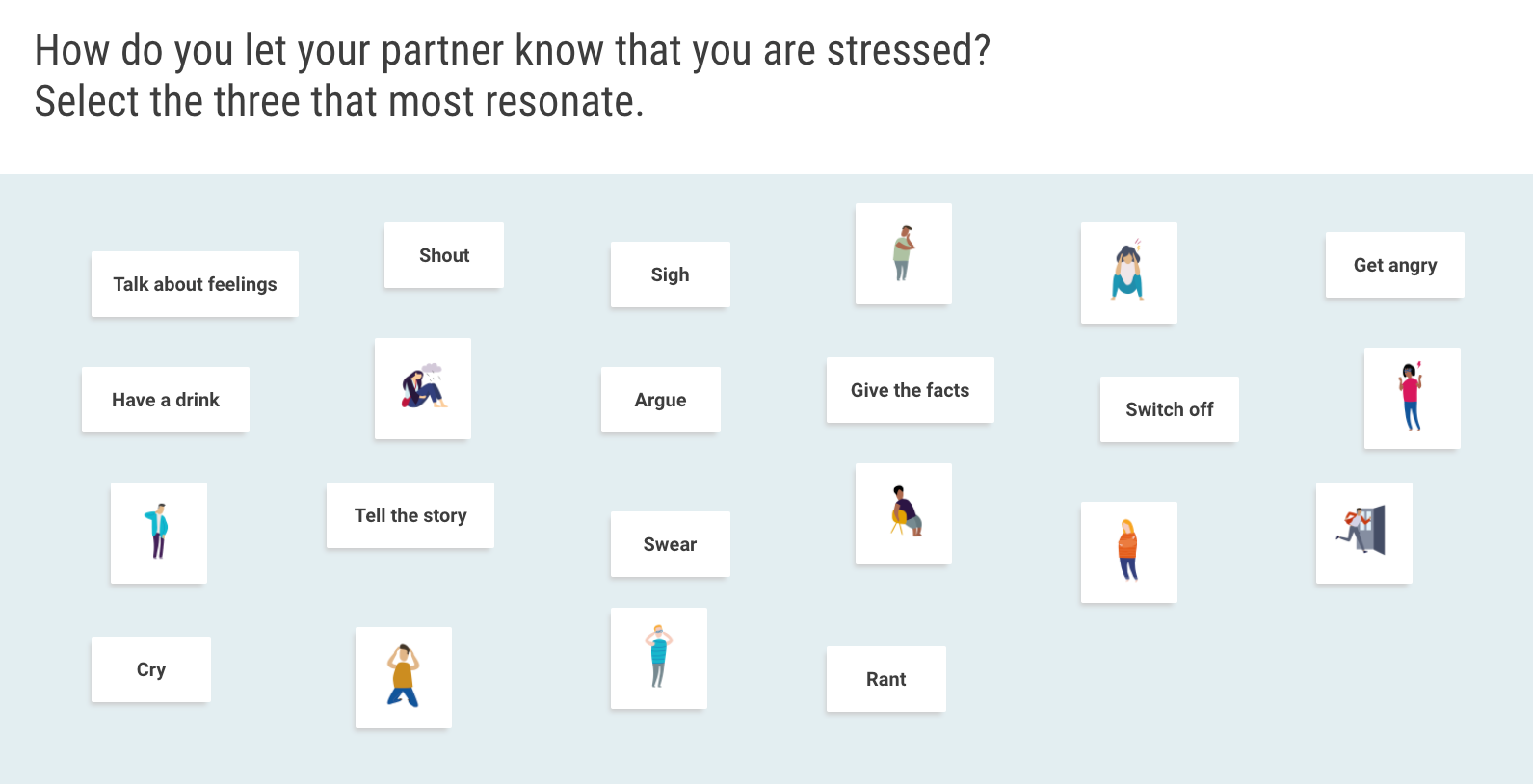
How do you know when your partner is stressed? How does your partner know when you are stressed?
We all show our stress in different ways. One person might cry or get angry, while another might be quieter and more withdrawn. Knowing how to recognise this is the first step to being able to offer support.
We might show stress VERBALLY, by talking about it.
We might show it NON-VERBALLY, through our body language and facial expressions.
In the next activity, we’ll ask you to reflect on the different ways that you and your partner let each other know when you’re feeling stressed.
Please note that this is a screenshot from the parent resource. To use the interactives, you will need to go to the parent resource.
When you’ve been through something stressful, you might just want to talk about what happened. This can help you get things off your chest, but it isn’t always enough. Your partner will know what happened, but they won’t necessarily know how it made you feel.
The next time you’re talking about stress, try to stick to the five rules. They can help you have better conversations with your partner.
Here is a helpful reminder of the five rules:
Recap on the learning from the clip and revisit the rules for communicating stress:
If you think the couple are having difficulty with this, there is an additional activity you can use to help develop the use of ‘I’ statements.
Encourage parents to try using ‘I’ statements, focusing on their feelings rather than using ‘you’ statements that can come across as an accusation of blame. Using an ‘I’statement helps a person become assertive without making any accusations.
‘I feel…’
‘When you…’
‘Because…’
‘WhatI need is…’
It may feel very strange for parents to approach their conversations in this way but with practice it can really help.
When your partner has a problem, you can offer support in two different ways:
1. EMOTIONAL SUPPORT: This is when you show that you have understood.
2. PRACTICAL SUPPORT: This is when you offer ways of solving the problem.
EMOTIONAL SUPPORT is important because it shows your partner that you are there for them. It is always better to listen first without offering advice.
This doesn’t mean you can’t offer PRACTICAL SUPPORT at all, but you should try to offer EMOTIONAL SUPPORT first.
You’ll see how this works in the next two clips.
Ada tells Jason about a problem. In the first clip, Jason offers PRACTICAL SUPPORT without offering emotional support.
Watch the first clip
Now watch the second clip.
This time, Jason offers EMOTIONAL SUPPORT first.
This time, Jason is a much better listener. He turns towards Ada and shows he understands: “Oh no.”
Ada then has a chance to talk about how she feels. Jason comforts her: “I’m sorry you had to deal with that on your own.”
Jason asks questions to find out more about the problem: “What do you think is causing it?”
He offers reassurance: “You’re not useless.”
Jason does offer practical support, but only after he has listened to Ada. When Ada suggests seeing the doctor, Jason says: “Let me book it.”
Can you see why Jason’s response was more helpful this time? Ada feels better supported emotionally, so it’s easier for her to accept the offer of practical support.
What else do you notice about the way Jason and Ada communicate with each other?
If the couple needs some extra help in offering each other emotional support, this additional activity might help.
Ask the parents to tell you about a recent time they felt stressed, focusing on:
This is the ‘funnel method’ of offering emotional support. You will be modelling relational skills – empathy, understanding, and acknowledging the other person’s feelings.
e.g. ‘I can see why that might make you feel scared/angry/sad.’
Now it’s time to set some goals. A goal can be a thing you want to happen, or a way you want to be. Goals are a good way to make sure you use the new skills you are learning.
What would you like to do differently?
You can either choose your own goal or pick one from our list:
It’s a good idea to pick something SPECIFIC that feels MANAGEABLE. Ask yourself, “Can I actually do this? How will I know when I’m succeeding?”
The most important this is to PRACTISE. Whatever goals you choose, try them out over the next few weeks. The more you practise, the better you will get.
Check in with the parents to see how they are progressing with their goals. If they haven’t set a goal yet, you can help them to choose one now.
They can choose their own goal, or you can suggest one based on their experiences so far. Some suggestions:
You can review their progress at the start of the next section.
In the final section, you will learn more about how to handle difficult conversations and disagreements with your partner.
What key messages can you remember? You have already learned a lot about dealing with stress:
How might you and your partner use these lessons in your lives? What do you think could change if you do?
This might be a good time to take another break and think about what you've learned so far.
When you're ready, come back and get ready for Section 3.
Please encourage parents to complete the ‘Check in’ questions at the end of Section 2.
Emphasise the key messages of this section: