Purpose: To help parents develop skills in communication and managing conflict, so they can argue in ways that are better for their relationship and better for their children.
Arguments can be constructive (helpful) or destructive (harmful). This section helps parents think about how their arguments start, and how they get out of hand. Most importantly, it will give them the skills to resolve arguments in more constructive ways.
All couples have disagreements. How you handle these can make a big difference to your relationship. When you and your partner argue, it can be HARMFUL or HELPFUL.
HARMFUL arguments can be BAD for your relationship, and hard for your children:
HELPFUL arguments can be GOOD for your relationship, and can help your children learn vital skills:
When couples have a lot of HARMFUL arguments, it can feel like they are on a downward spiral, moving away from each other.

All couples argue but some conflict behaviours are more damaging than others. Encourage the parents to reflect on their own behaviour and how that might make each other feel.
Ask them to think about the way they argue, and how it might make their children feel. For many parents, this can provide the motivation for behaviour change.
Have a look at the next clip
Now think about your own relationship.
Discuss the animation. Ask the couple to identify what they argue about and why, and to think about how little things can turn into big arguments. Understanding why arguments happen is the first step in stopping them from getting out of control.
John Gottman, a famous relationship researcher, found that couples have better relationships when their POSITIVE MOMENTS outweigh their NEGATIVE MOMENTS.
For every NEGATIVE MOMENT between you and your partner, you need FIVE POSITIVE MOMENTS to balance it out.
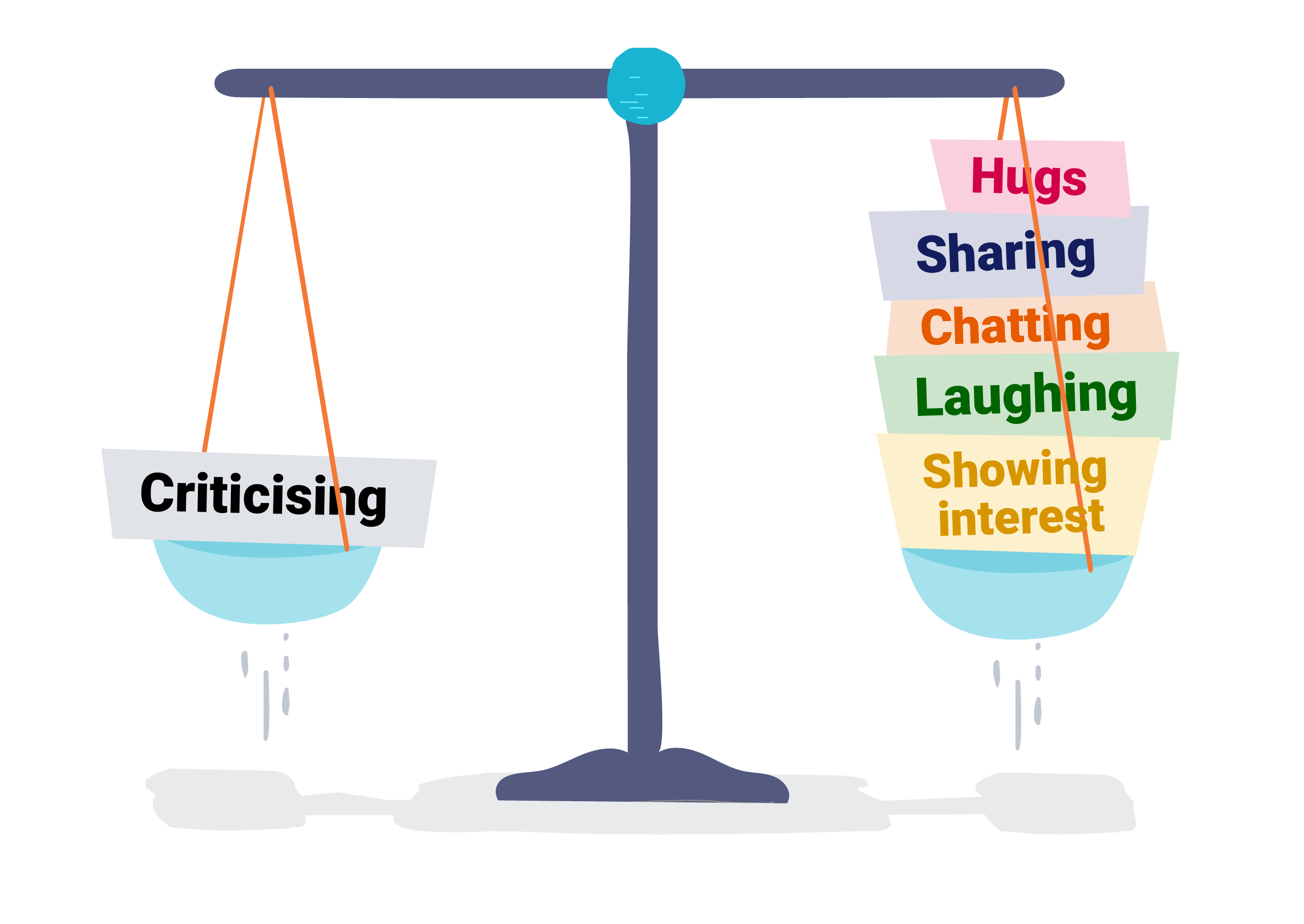
The difference between happy and unhappy couples is the balance between positive and negative interactions in their relationship. The “magic ratio” is 5 to 1.
For a relationship to remain stable and happy, it needs at least five positive interactions to balance out each negative reaction.
Encourage the couple to think about the things they do to make each other feel cared for. What are the positive things they say and do with one another?
How well do you and your partner CURRENTLY get on?
In the next activity, you’ll see a sliding scale. Take a look and think about where on this scale you might be.
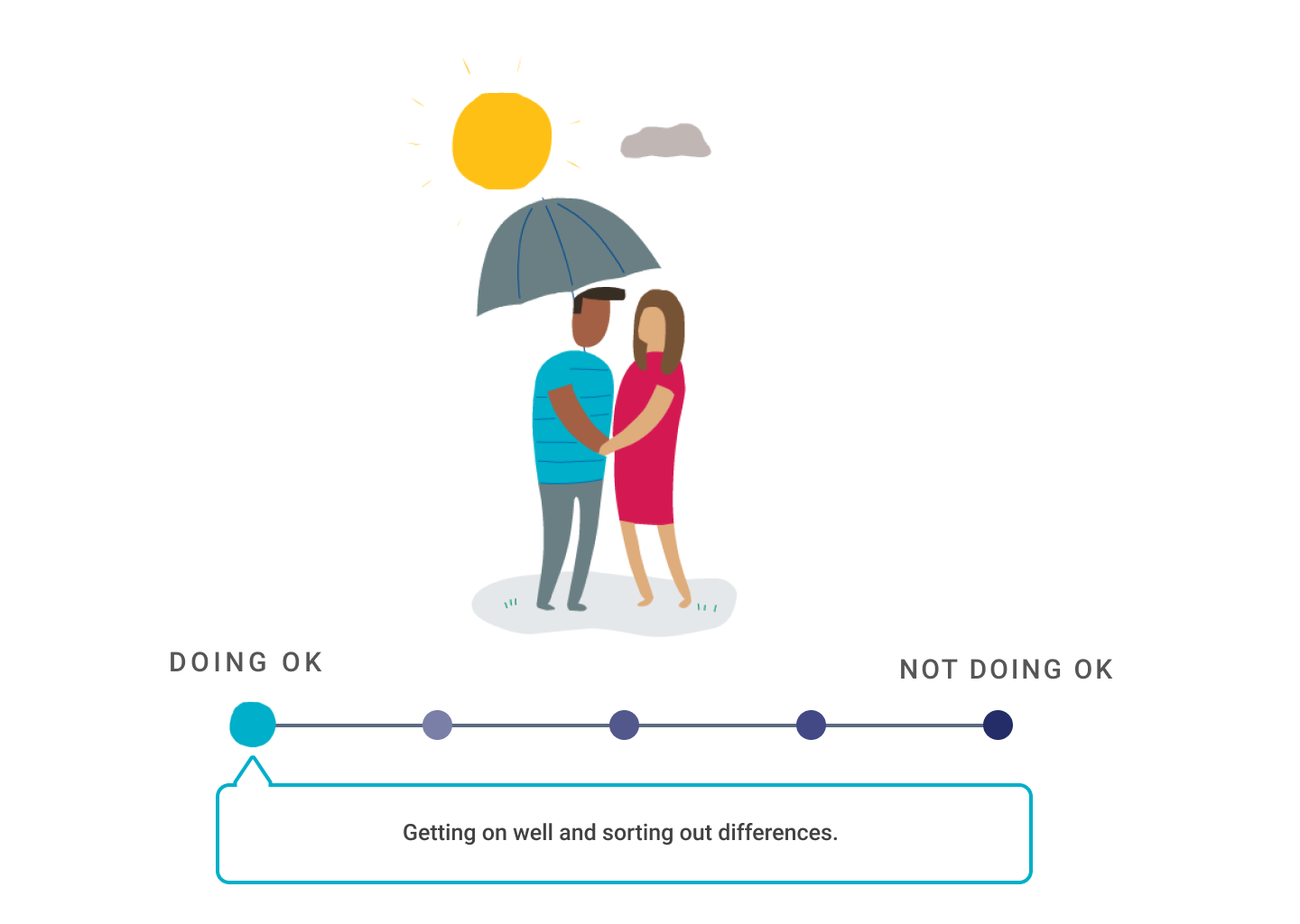
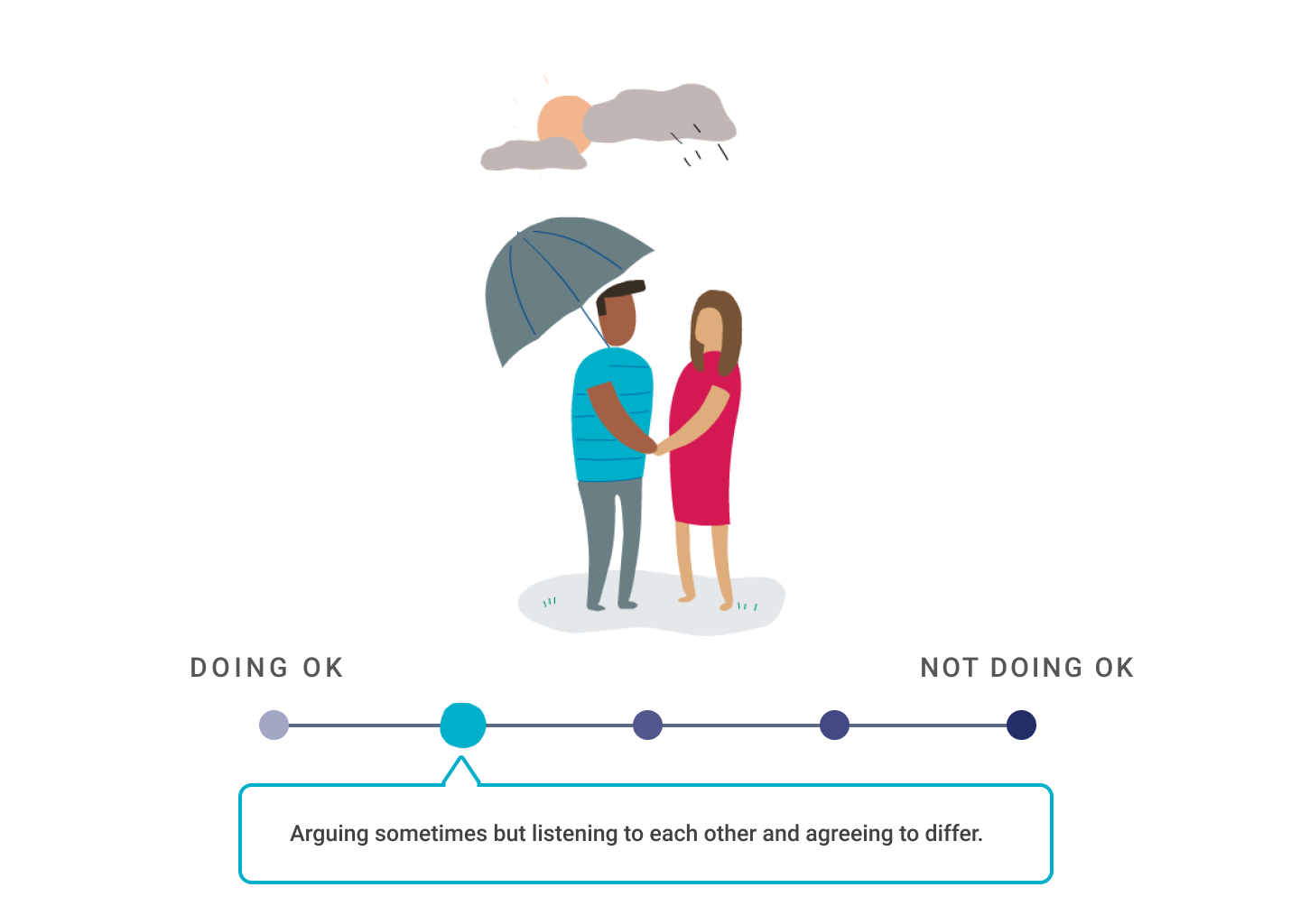
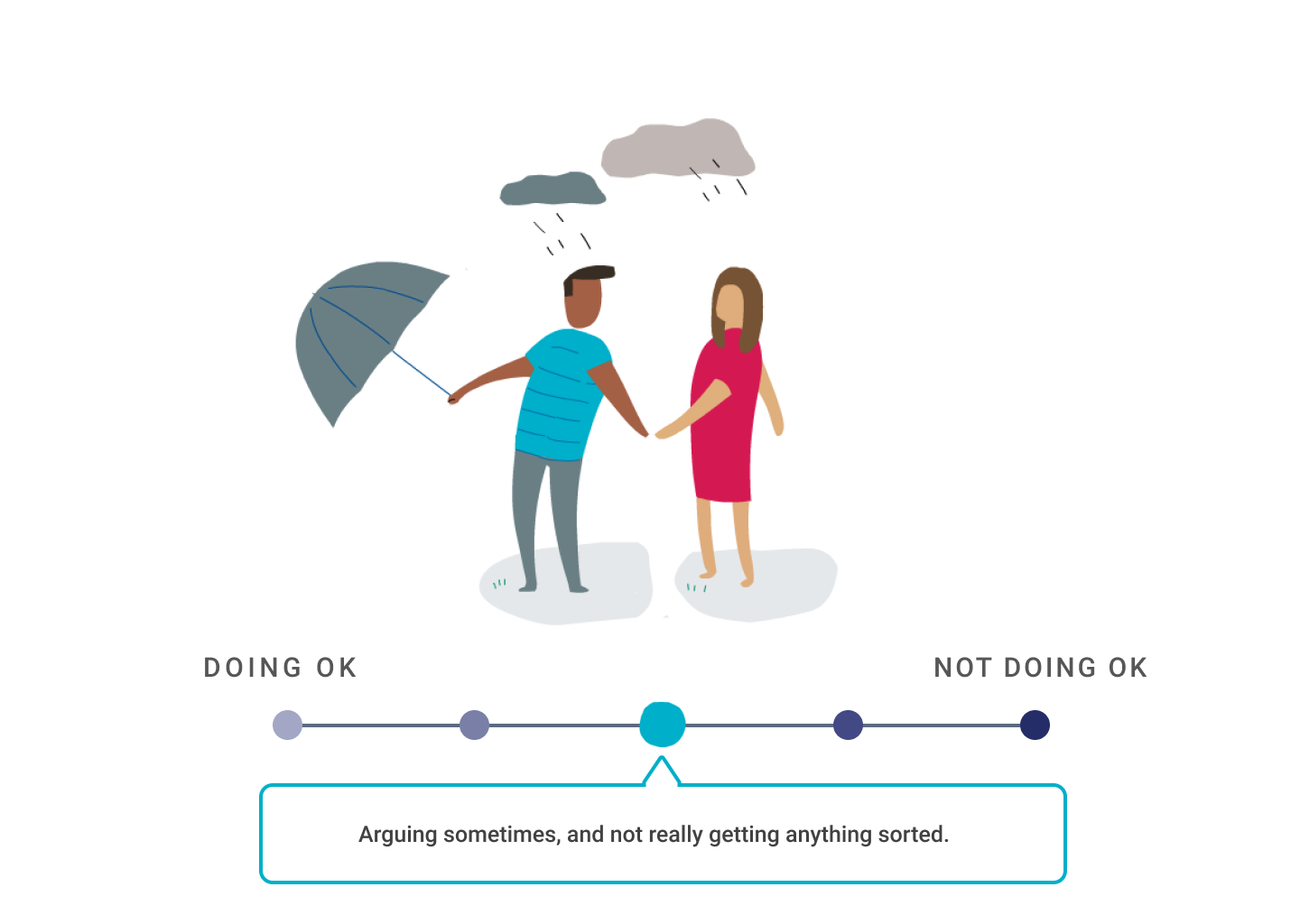
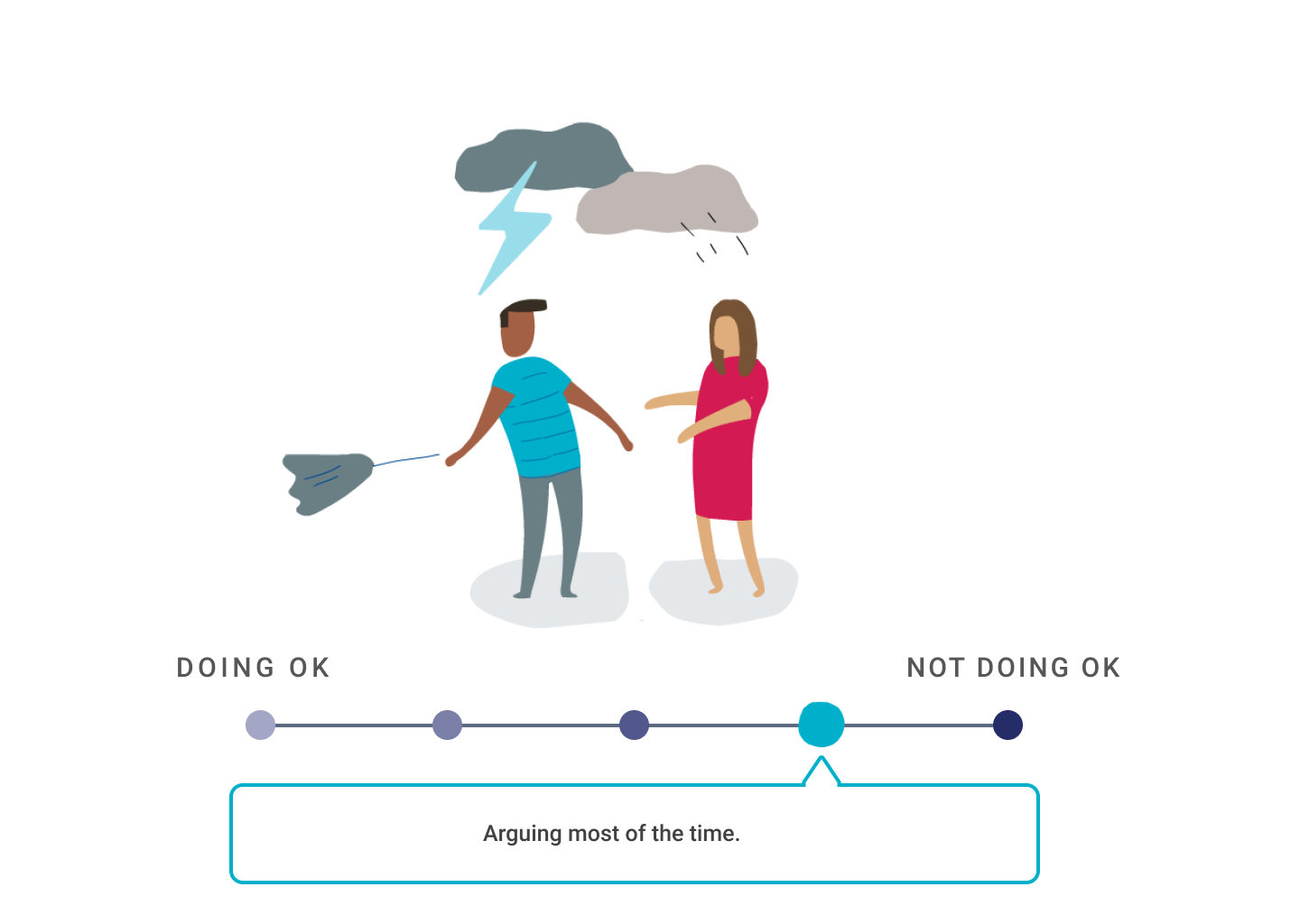
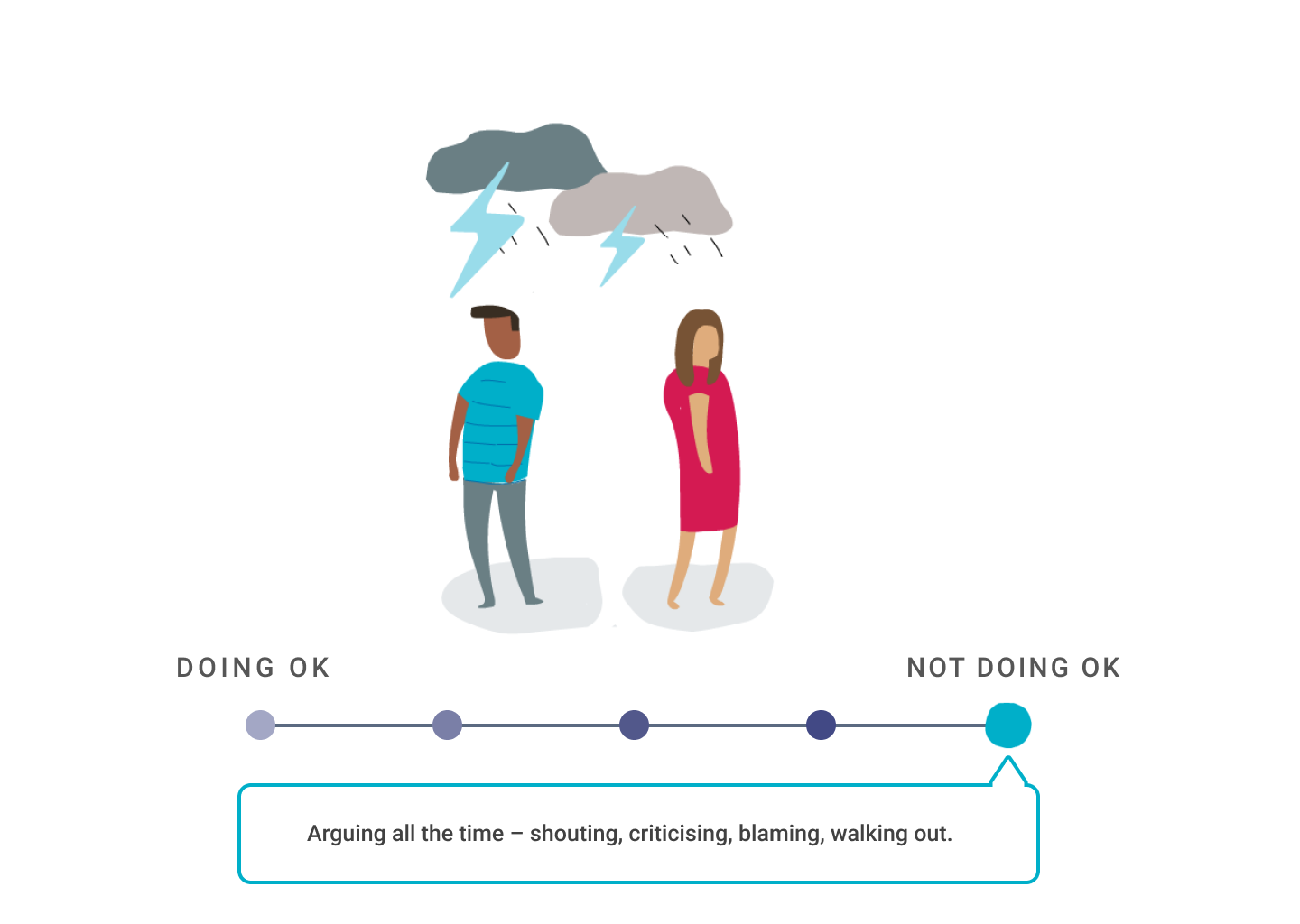
It’s OK if you’re not yet where you’d like to be. It just means you need to think about the changes you might need to make.
These questions can help you think about how you might start to do that:
The sliding scale tool is used both for assessment (Where are you at? How well do you currently get on?) and solution-focused discussion (Where would you like to be?).
Explain that relationships can move up and down a scale. The umbrella symbolises the factors that help protect relationships during difficult times – humour, affection, time together, support, etc.
Ask parents to share with you where they think they are on this scale.
This will highlight how they see their level of conflict and if there are any discrepancies.These are the questions they will have explored:
Use solution-focused questions to come up with ideas specific to the couple if they haven’t already done this. Talk about how they would like their relationship or communication to be different and how they can build on their strengths.
These questions can help parents think about:
Offer positive affirmations on any progress so far. Behaviour change can be difficult for many parents.
How can you turn HARMFUL arguments into HELPFUL arguments?
When you know that an argument is happening, the first thing to do is STOP. This means:
In the next clip, you’ll see how a conversation gets out of hand and becomes a harmful argument.
In this clip, Jason CRITICISED Ada about the mess. Ada reacted by DEFENDING her position. This led to a HARMFUL ARGUMENT.
Jason and Ada were:
On the next page, you will hear how Jason and Ada felt in this situation.
Discuss the first clip, ‘A harmful argument’, with the couple.
Did they spot how destructive (harmful) conflict behaviours caused the argument to escalate? Jason and Ada were critical, defensive, blaming each other and trying to win the argument.
Listen to how Jason and Ada felt when they were arguing.
There are three important skills that can help make your arguments more HELPFUL.
1. Stay calm
When you are calm, it’s easier to stop the conversation from getting worse:
2. Listen
Sometimes, when we should be listening, we are too busy thinking about what we are going to say next. When you really listen, it will be easier to understand your partner’s point of view.
3. See things differently
It’s easy to assume the worst, but you won’t always know the whole story. Try and see things from your partner’s point of view before you respond.
On the next page, you’ll see the same situation playing out as a HELPFUL ARGUMENT.
Discuss the first clip, ‘A harmful argument’, with the couple.
Did they spot how destructive (harmful) conflict behaviours caused the argument to escalate? Jason and Ada were critical, defensive, blaming each other and trying to win the argument.
Now watch the next clip to see how things can go better when you stay calm, listen, and see things differently.
On the next page, you will hear how Jason and Ada felt in this situation.
Discuss the second clip, ‘A helpful argument’, with the couple. Did they spot how constructive (helpful) conflict behaviours allowed Ada and Jason to resolve the argument in a more helpful way? Jason stayed calm and listened to Ada. This helped Ada to tell him how she felt.
Encourage the couple to reflect on how Ada and Jason saw things from each other’s point of view. What did they learn about how to handle an argument?
Remind them that the next time they get into an argument with one another, the first step is to STOP:
Listen to how Jason and Ada felt when the situation was going better.
Next time you find yourself getting drawn into an argument with your partner, remember – the first step is to STOP:
Only then can you start to sort out the problem.
Discuss the second clip, ‘A helpful argument’, with the couple. Did they spot how constructive (helpful) conflict behaviours allowed Ada and Jason to resolve the argument in a more helpful way? Jason stayed calm and listened to Ada. This helped Ada to tell him how she felt.
Encourage the couple to reflect on how Ada and Jason saw things from each other’s point of view. What did they learn about how to handle an argument?
Remind them that the next time they get into an argument with one another, the first step is to STOP:
Now it’s time to set another goal. Goals are a good way to make sure you use the new skills you are learning.
What would you like to do differently?
You can either choose your own goal or pick one from our list:
Remember to pick something SPECIFIC that feels MANAGEABLE. Ask yourself, “Can I actually do this? How will I know when I’m succeeding?”
And, as before, the most important this is to PRACTISE. Whatever goals you choose, try them out over the next few weeks. The more you practise, the better you will get.
Check in with the couple. Have they been able to set a goal? If not, you may have to make some suggestions. Start small and encourage them to practise regularly. Here are some suggestions:
You can give positive feedback on their progress so far and encourage them to keep practising.
Please encourage parents to complete the questions at the end of Section 3.
OnePlusOne are continuously evaluating this digital resource. We are keen to understand how well parents have understood the content of Arguing better and whether it has a positive effect on their behaviour. For that reason, there are questions, using standardised measures, woven into the resource to gauge parents’ responses and outcomes. We would really appreciate it if you could encourage parents to complete all of the questions by letting them know that their feedback and participation is important in making the resource the best it can be.
We are also interested in your feedback on the ‘Arguing better’ resource and practitioner guide. If you're happy to be contacted by our researcher, please leave your email address below.
In this last section, you learned about how to have better conversations with your partner:
As you go about your daily life, keep an eye out for moments when these skills could be useful. Check in with your partner from time to time and remember that you can always come back here if you want to look at anything again.
Thank you.
Check in with the parents to see how they are progressing with their goals. You may want to make another appointment to check how they are progressing and the changes they are making.
Emphasise the key messages of this section: