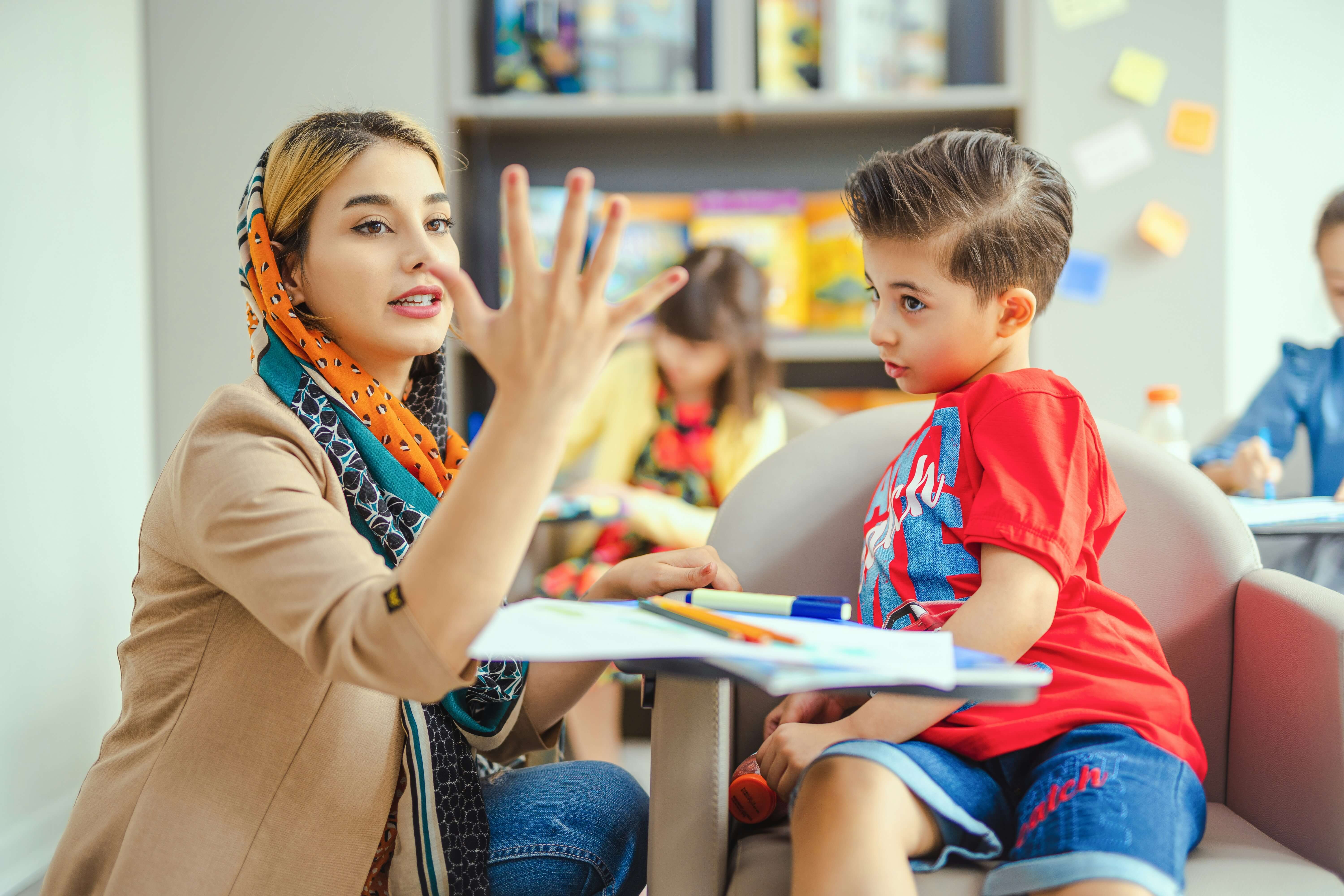
When your child starts school, it's a big milestone for everyone in your family to navigate. Schedules change, drop-offs and pick-ups need to be arranged, and teachers become a big part of everyday life. A great way to help strengthen your child's school experience is to build a positive relationship with their early years teacher.
A strong parent-teacher relationship can support your child’s social and emotional development – an important part of school readiness. It can also make it easier for you to share concerns, understand how your child is doing, and work out any issues together. Having a positive relationship with your child’s teach can even lead to your teacher having a better relationship with your child (Jeon et al., 2021).
Here are some tips to help you and your child's teacher stay on the same page.
Communication is key
Studies have shown that good communication between parents and their children’s teachers can nurture both teacher and parent understanding and support for a child, which then increases your child’s motivation and success in school (Ozmenet al., 2016). This is why it's important to keep a two-way conversation open between you and the teacher.
Rather than waiting for scheduled parent-teacher meeting days, could you make time to check in with the teacher on a regular basis? Remember that a two-way conversation means listening to your child’s teacher as well as talking to them. It can be hard to hear suggestions from a teacher and it may sometimes feel like criticism. Try to listen with an open mind and trust that your child’s teacher wants the best for your child just as you do.
Sharing is caring
Your child is a unique individual with their own habits and challenges. When you meet with your child's teacher, they may ask questions about how your child is currently doing. It's worth being honest and thorough here, as the teachers will take this into account and use it to help your child fit into the classroom (Leenders et al. 2019). It doesn't mean you have to overshare. Just tell the teacher about what to expect with your child and ask your own questions to ensure your child remains the centre of the conversation.
Find common goals
If you can establish from the start that your communication with the teacher is focused on your child's learning abilities and their conduct in school, it can help develop a healthy child-centric relationship (Chatzinikola, 2022). Figuring out where your child is excelling and struggling in school, while making a list of goals for you and the teacher to work towards will help your child excel – and make the teacher feel you are both on the same team.
Stay up to date
Having young children starting in school and trying to figure out a new routine can be hard for parents. We know – you're busy! As best you can, try to read every pamphlet that is brought home or email that is sent through. This one-way communication helps teachers inform parents in various ways, helps you know what to expect for your child, and will allow you to ask the right questions to the teacher if you need to reach out to them (Chatzinikola, 2022).
Be positive at home
When your child is at home with you, do your best to keep conversations and questions about things school, like homework, projects, lessons, and teachers, positive and encouraging. This shows your child that you are interested in their school days. It can also improve your child’s perception of school and positively affect how they adjust to the school environment (Santiagoet al., 2016). By sharing your interest with your child, you will allow them to feel closer to you and know that they are able to trust their school and their teacher.
Your child’s learning doesn’t have to end in the classroom – they can also learn a lot from you at home. Activities like reading together, talking about things your child enjoys, going to the library, and even signing songs can all benefit your child’s learning experience. This is sometimes referred to as the home learning environment, as your child benefits from all sorts of shared activities.
There are a lot of ways to improve your relationship with your child's teacher. It's important to remember that they are only human, and things won’t always go perfectly, especially if they are working under lots of pressure. However, encouraging a relationship with your child's teacher can help them to see you are more involved and informed, all of which can benefit your child in school and beyond.
References
Chatzinikola, M. (2022). Communication management of parent participation in education process: Practices of communication between teachers and parents. European Journal of Education and Pedagogy, 3(3), 1-6.
HM Government. (2018). Improving the home learning environment: A behaviour change approach.
Jeon, H.J., M. McCartney, C., Richard, V., Johnson, S.J. and Kwon, K.A., (2021). Associations between parent-teacher and teacher-child relationships and children’s socioemotional functioning. Early Child Development and Care, 191(15), pp.2407-2421.
Leenders, H., de Jong, J., Monfrance, M., & Haelermans, C. (2019). Building strong parent–teacher relationships in primary education: the challenge of two-way communication. Cambridge Journal of Education, 49(4).
Ozmen, F., Akuzum, C., Zıncırlı, M., & Selcuk, G. (2016). The communication barriers between teachers and parents in primary schools. Eurasian Journal of Educational Research, 16(66), 27-46.
Santiago, R. T., Garbacz, S. A., Beattie, T., & Moore, C. L. (2016). Parent‐teacher relationships in elementary school: An examination of parent‐teacher trust. Psychology in the Schools, 53(10), 1003-1017.