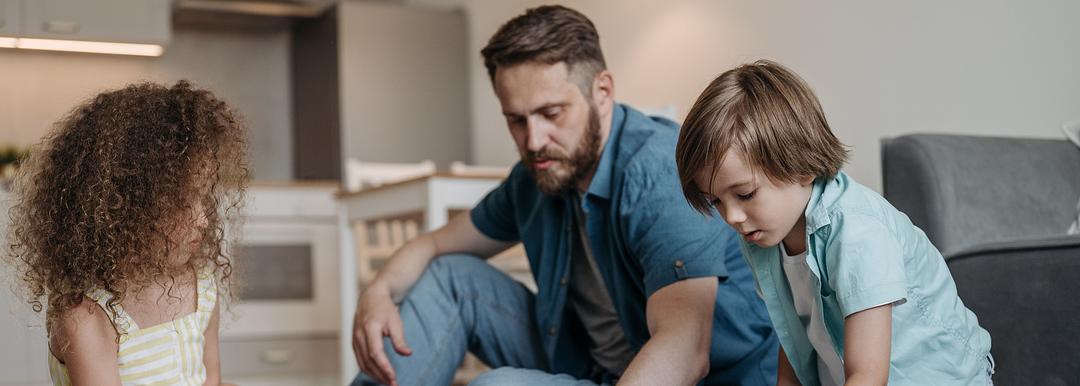
Picture a group of children playing. They’ve created a spontaneous made-up world. Perhaps they have assigned each other characters and tasks: “Olive is a bear, we’ve got to sneak past the cave without waking her up,” or “We need to get all of the cars into the car park before midnight.”
These games might seem like a bit of silly fun but there’s so much going on under the surface. Research has shown that play is an essential part of children’s brain development.
Playing helps children learn social skills that help them to:
- Get on well with others.
- Manage their emotions.
- Follow instructions.
- Make decisions.
- Be creative.
- Solve problems.
- Focus on tasks.
- Stand up for themselves (Yogman et al., 2018).
While they’re having fun, they’re also discovering new interests and developing their creativity at a pace that suits them (Ginsburg et al., 2007). When children lack opportunities to play, they can miss out on these essential learning moments.
What children learn from each other
Play usually happens for its own sake, often spontaneously. It’s something children actively engage with, and there’s no real goal other than enjoyment. This is why you’ll often see children lost in play, engrossed in a world of their own making, with rules that bend and change as they imagine new realities (Yogman et al., 2018).
When children play together, they pick up lots of new skills.
Respecting boundaries
Rough-and-tumble play – things like playfighting, or chasing each other – has clear physical benefits but it also teaches children to respect boundaries. In these games, children need to communicate the rules, take risks, and try to win without hurting each other. They are practising empathy, managing their emotions, and learning to negotiate.
Cooperation and imagination
When children play make-believe games, they learn to collaborate, working within a set of evolving social rules. Think of a child who pretends to be a teacher and invites the other children to class. Each character needs to exist within the reality of the game, agreeing how things work, resolving disputes, and treating each other appropriately.
Expanding horizons
Playing outdoors, whether it’s in a local park or the school playground, can help children meet others from diverse backgrounds, developing new friendships that help them learn and grow (Yogman et al., 2018).
What children learn from their parents
When parents and children play together, there are a number of subtle but important things going on. Let’s imagine your child tells you they are running a café and are now open for business. You are their first customer. You buy a cup of coffee, drink it, and then decide to carry on the game.
- You: “That was delicious, could I have another one please?” You are responding to your child’s cues, showing empathy by respecting the reality of the world they have created, and allowing the play to continue.
- Your child: “I’m sorry, we’ve just run out of coffee, you’ll have to wait while we make some more.” Your child is responding to your cue, building on your suggestion.
- You: “OK, I’ll wait here. Let me know when you’re ready.” You’re syncing up with your child, agreeing to work within the boundaries they are developing.
- Your child: “You’ve got to queue up on this side and then wait over there while I prepare your order.” Your child is now directing you, guiding you through the changing rules (Ravindran & McElwain, 2024).
As these interactions sync up, you start to play off each other, moving the game along together. By remaining sensitive to your child’s needs and wants in each moment, you are showing them how to give and take in real-life social interactions. They are learning when to be assertive, and when to let the other person have their way. All of this from a made-up café!
Making friends
Your interactions with your child then feed back into the way they play with other children, which can make a real difference to how they make friends.
Children who play positively are more likely to be accepted by their peers. Even as young as three or four, children notice how their peers are behaving. When a child is encouraging, helpful, or sharing, they are more likely to be accepted and welcomed. Children who are disruptive can cause concern for other children, which can make it harder for them to make friends (Coelho et al., 2017).
As a parent you can provide valuable guidance through your own playtime, demonstrating cooperative behaviour, and letting them see the value of sharing and being kind.
A glimpse into their world
Playing with your children, or even just watching them play with others, lets you see the world from your child’s perspective (Ginsburg et al., 2007). Notice the realities they create, and how they navigate them. If your child builds a world around them, what could that tell you about how they see the real world, and what they want from it?
It might seem silly or insignificant, but play is a glimpse into the unique world where your child is learning how to be a person. When your child asks you to play with them, they are offering you an opportunity to get alongside them and live in that world for a moment – and all you have to do is believe.
References
Coelho, L., Torres, N., Fernandes, C., & Santos, A. J. (2017). Quality of play, social acceptance and reciprocal friendship in preschool children. European Early Childhood Education Research Journal, 25(6), 812-823.
Ginsburg, K. R., Committee on Communications, & Committee on Psychosocial Aspects of Child and Family Health. (2007). The importance of play in promoting healthy child development and maintaining strong parent-child bonds. Pediatrics, 119(1), 182-191.
Ravindran, N., & McElwain, N. L. (2024). Dynamic coupling of maternal sensitivity and toddlers’ responsive/assertive behaviors predicts children’s behavior toward peers during the preschool years. Developmental psychology, 60(10), 1801.
Yogman, M., Garner, A., Hutchinson, J., Hirsh-Pasek, K., Golinkoff, R. M., Committee on Psychosocial Aspects of Child and Family Health, & Council on Communications and Media. (2018). The power of play: A pediatric role in enhancing development in young children. Pediatrics, 142(3), e20182058.